In its crystalline, liquid and glassy states, iron has an affinity for carbon, whether to form a solution over a wide range of compositions, as graphite or diamond, or in the form of compounds with narrowly defined compositions, such as cementite. It is possible, therefore, to find equilibria between iron and graphite, iron and diamond and iron and cementite, represented conventionally by the respective binary, two-phase diagrams. Such diagrams identify domains, for example in temperature and composition space, where either a single phase or a combination of phases is stable.
However, the term stable is a tenuous concept, because there might be something else also consisting of Fe and C, which may be more stable. Instead of considering just two phases together, if we now put iron, graphite and cementite in mutual contact at ambient pressure then the cementite eventually must give way to the more stable equilibrium between graphite and iron. All equilibria in this sense are metastable; even the constituents of atoms will all decay eventually if the Universe keeps on expanding.
Some 50 million tonnes of cementite is produced annually within about 1.6 billion tonnes of steel, adding enormously to the quality of life. This is because it is hard at ambient temperature, as we shall see, due to its crystal structure that has a much lower symmetry than all the forms in which the iron occurs. Its metastability mostly does not matter over the time scale and conditions of normal life.
The name has its origins in the theory of Osmond and Werth, in which the structure of solidified steel consists of a kind of cellular tissue, the iron constituting the nucleus and the carbide the envelope of the cells. The carbide was therefore envisaged to cement the iron.
In mineralogy, the carbide is known as cohenite (Fe,Ni,Co)3C, after the German mineralogist Emil Cohen, who was investigating material of meteoric origin. The impact of carbon-containing meteorites with the moon is speculated to lead to a reduction of the iron-containing minerals on its surface; the resulting reaction with the carbonaceous gases generated by the impact to produce cementite (Jull:1975). Cementite is in fact of much wider interest than in metallurgy alone, within subjects spanning from astrophysics, planetary science, Lunar processes, and biomedicine to name but a few.
How was its chemical composition established given that the nature of carbon inside steel could not have been understood in the very early days of metallography? In 1878, Müller dissolved some steel in dilute sulphuric acid to leave behind a black residue which when analysed contained 6.01–7.38 wt% carbon. Müller referred to this as amorphous iron. Comprehensive experiments done independently by Abel around 1883 were published in 1885 in a report on the state of carbon within steel. This confirmed "the correctness of the conclusions based on earlier experiments, that the carbon in cold-rolled steel exists in the form of a definite iron carbide, approximating the formula Fe3C or to a multiple of that formula". In the same experiments, hardened steel (presumably martensitic) "appeared to have the effect of preventing or arresting the separation of carbon, as a definite carbide".
Structure of cementite
Cementite has an orthorhombic unit cell and the common convention is to set the order of the lattice parameters as a = 0.50837 nm, b = 0.67475 nm and c = 0.45165 nm. Note that the order in which the lattice parameters are presented here is consistent with the space group Pnma. There are twelve atoms of iron in the unit cell and four of carbon. Four of the iron atoms are located on mirror planes whereas the other eight are at general positions (point symmetry 1).
The lattice type is primitive (P). There are n-glide planes normal to the x-axis, at (1/4)x and (3/4)x involving translations of (b/2) + (c/2). There are mirror planes normal to the y-axis and a-glide planes normal to the z-axis, at heights (1/4)z and (3/4)z with fractional translations of a/2 parallel to the x-axis. The space group symbol is therefore Pnma.
The crystal structure of cementite, consisting of twelve iron atoms (large) and four carbon atoms (small, hatched pattern). The fractional z coordinates of the atoms are marked. Notice that four of the iron atoms are located on mirror planes, whereas the others are at general locations where the only point symmetry is a monad. The pleated layers parallel to (100) are in ...ABABAB... stacking with carbon atoms occupying interstitial positions at the folds within the pleats, with all carbon atoms located on the mirror planes. There are four Fe3C formula units within a given cell.
The carbon atoms in cementite are located in interstitial sites; any deficit from the 3:1 Fe:C atom ratio is attributed to vacant interstices that normally are occupied by carbon atoms, as inferred from lattice parameter changes, originally pointed out by Petch (1944). The specific volume of cementite that is in equilibrium with ferrite at ambient temperature is found to be greater than that calculated using its measured lattice parameters, indicating those vacant carbon sites, i.e., a deviation from the stoichiometric composition (Kayser:1997).
The figure below shows the thermodynamically assessed phase boundaries between cementite θ and ferrite α or austenite γ. Cementite has traditionally been depicted as a line compound in phase diagram calculations, but it has been shown that a thermodynamic model that permits its free energy to vary in a manner consistent with experimental data (Gohring:2016), is able to reproduce the equilibrium γ+θ/θ and α+θ/θ phase boundaries.
(a) The composition of cementite that is in equilibrium with austenite or with ferrite in an Fe-C alloy. The data are due to Leineweber et al., determined by measuring the lattice parameters of cementite following quenching from the appropriate temperature.
(b) Free energy curve of cementite as a function of chemical composition (referred to γ-Fe and graphite). After Gohring et al.
Any deviations from stoichiometry must be small, because as demonstrated by Cottrell (1993), the bond energy between a carbon atom and iron is greater than that between two iron atoms. Circumstances can be engineered to make the cementite deviate from the stoichiometric carbon concentration; the decarburisation of pure cementite (Stuckens:1961) leads to changes in the volume of the unit cell and in the Curie temperature. The deviation tends to be small, typically Fe3C1-x with x ≅ 0.02.
Circumstances can be engineered to make the cementite deviate from the stoichiometric carbon concentration; the decarburisation of pure cementite (Stuckens:1961), which leads to changes in the volume of the unit cell and in the Curie temperature of cementite, is an example. The deviation tends to be small, typically Fe3C1−x with x ≅ 0.02. There are reports that very small particles of cementite in the structure of iron alloys studied by the atom probe technique exhibit deviations from stoichiometry, but these results should be treated with caution because at small size, the surface energy plays a role in determining the composition of the cementite in equilibrium with the surroundings.
The atom probe permits the composition of cementite to be measured directly using time-of-flight mass spectroscopy. There are, nevertheless, difficulties in measuring the carbon concentration of cementite (Kitaguchi:2014). It has not yet been possible to demonstrate small deviations from stoichiometry using such high-resolution methods. However, using conventional atom probe field ion microscopy, extremely small (4 nm) cementite particles in severely deformed mixtures of ferrite and cementite have been shown to contain only 16 at% of carbon, a concentration that recovers to the 25 at% when the mixture is annealed to reduce the defect density and coarsen the cementite (Hong:1999). It is argued that the deformation introduces defects such as vacancies into the cementite, leading to the reduction in carbon concentration. However, it is important to note that the particles containing such a large deviation from stoichiometry were not proven to retain the orthorhombic crystal structure.
Thermal properties
The average thermal expansion coefficient of polycrystalline cementite changes from 6.8 × 10⁻⁶ K−1 to 16.2 × 10⁻⁶ K−1 as the sample is heated to beyond the Curie temperature (Umemoto:2001).
The linear thermal expansion coefficient of polycrystalline cementite as a function of temperature and magnetic state. Adapted using data from Umemoto et al. (2001).
Shown below are diffraction data (Reed:1997, Wood:2004, Litasov:2015) for each of the lattice parameters of cementite as a function of temperature. The parameter a is most sensitive to the change from the ferromagnetic to paramagnetic state, with a contraction evident as the temperature is raised within the ferromagnetic range.
An increase in the amplitude of thermal vibrations in an anharmonic interatomic potential causes expansion, but the spontaneous magnetisation leads to a contraction, and this latter effect dominates the a parameter below TC, leading to the observed Invar type effect, although it is known that the analogy with the Invar effect in austenite is tenuous. The orthorhombic structure is preserved through the transition at TC. It is not clear why the a parameter is particularly affected by the magnetic transition.
Neutron and X-ray diffraction data on the three lattice parameters a, b and c of cementite as a function of temperature. Data from Wood (2004) (small circles with error bars), Reed (1997) (filled circles) and Litasov (2015) (crosses). The dashed line in each case identifies the Curie temperature.
The calculated pressure dependencies of the lattice parameters are as follows (Gorai:2018): Δa = 0.0041 × P, Δb = 0.00578 × P and Δc = 0.00374 × P Å, where the pressure P is in GPa.
Cementite at ambient pressure and room temperature is a metallic ferromagnet that becomes paramagnetic beyond the Curie temperature TC. The very first measurement was by Wologdine in 1909, in which particles of cementite suspended between magnetic poles were seen to collapse as the temperature was increased, giving TC = 180°C. Smith in 1911 indicated changes in magnetometer readings due to cementite contained in steel to be between 180–250°C, claiming the actual Curie temperature to be around 240°C. Honda in 1915 put this value at 210°C. The magnetic moment at 0 K is calculated to be about 1.86 μB.
There is a calculated transition from ferromagnetic to non-magnetic at 25 GPa pressure and 300 K. The term non-magnetic is used here because it is not clear whether the magnetic collapse corresponds to a loss of spin correlation or to a transition from a high-spin to a low-spin state. There is a volume contraction of 2–3% following the transition to the paramagnetic state. The structure, with its orthorhombic symmetry, is magnetically anisotropic, with [001] and [010] being the easiest and second easiest, and [100] the hardest magnetisation directions.
Preparation of cementite
Samples of bulk, pure cementite are difficult to prepare given that cementite in contact with iron is less stable than the corresponding equilibrium between graphite and ferrite. The largest samples have been manufactured by mechanical alloying in experiments by Umemoto et al. (2001). Powders of iron and graphite in the correct stoichiometric ratio are milled together, resulting in a solid solution, as indicated by very broad (≅15°) X-ray diffraction peaks in locations typical of body-centred cubic iron.
(a) A sample of cementite, courtesy of Professor Minoru Umemoto of Toyohashi University.
(b) Reaction of 80 wt% Fe and 20 wt% graphite for ten minutes at the temperatures and pressures indicated. Selected data from Tsuzuki (1984).
The mechanically alloyed powder was then spark plasma sintered under vacuum at 50 MPa pressure for 300 s at 1173 K, inducing the formation of cementite. The density achieved was 7.5 g cm−3, which is less than the measured value for pure cementite of 7.662 g cm−3 (Ishigaki:1927), indicating a degree of porosity in the sintered samples.
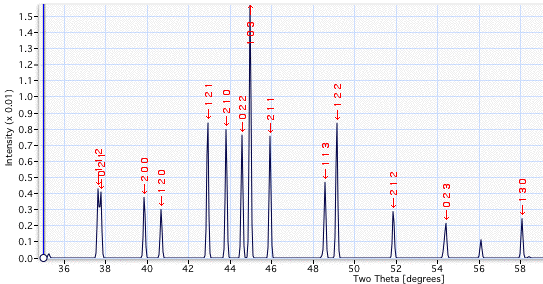
A comparison of the {110}α X-ray peaks from the experiments of Umemoto et al. (2001) and Joubouri et al. (2018) – the latter has been corrected to the Co Kα wavelength to permit the comparison.
It has been proposed, based on evidence from Mössbauer spectroscopy, that there are intermediate stages between the formation of the solid solution during milling and that of cementite. The process may first involve transition carbides such as Hägg (Fe2C) and ε-carbide, followed by cementite (Matteazzi:1991). Cementite can be made directly from Hägg carbide through the reaction Fe + Fe2C → Fe3C (Hofer:1950).
A clever method (Yamamoto:2018) for fabricating a "single crystal" of cementite is to incorporate electrolytically extracted cementite particles into a resin which then is subjected to a 10 Tesla magnetic field for some 24 h, with the composite periodically rotated in the field to magnetically align the particles as the resin solidifies.
Nanoparticles of cementite can be prepared by the thermal decomposition of Fe(CO)5 (iron pentacarbonyl). These fine particles may be of use in biomedicine for delivery of drugs to specific locations within the body, with the localisation achieved by an external magnetic field (Ramanujan:2009). Cementite is more corrosion and oxidation resistant1 while retaining sufficient ferromagnetism to implement the delivery mechanism.
Elemental-iron particles have been proposed for this purpose but they tend to oxidise (Shultz:2009). Cementite is more corrosion and oxidation resistant1 while retaining sufficient ferromagnetism to implement the delivery mechanism. Dispersions of polymer-coated cementite nanoparticles have been manufactured by subjecting a gaseous mixture of C2H4/Fe(CO)5/C5H8O2 to a continuous wave CO2 laser pyrolysis (Morjan:2009).
Cementite powder containing pores about 20 nm in size was produced from an aqueous mixture of iron chloride, colloidal silica and 4,5-dicyanoimidazole. The dicyanoimidazole is the source of carbon when the mixture is heated to 700°C to produce the powder of cementite, which also contains amorphous silica. The silica is then removed by solution in sodium hydroxide, leaving the porous cementite with a high specific surface area.
This cementite was demonstrated to be catalytically active in the decomposition of ammonia into a mixture of hydrogen and nitrogen. Cementite apparently has greater stability under harsh conditions than metallic iron, and is safer with respect to the danger of explosions associated with fine metallic powders (Kraupner:2010). Cementite has in fact been shown to exhibit catalytic activity even in the classical Fischer-Tropsch process for converting gaseous components into hydrocarbon liquids (Shultz:1956).
This study guide provides a detailed synthesis of the physical, chemical, and structural properties of cementite (Fe3C), an essential constituent in steel metallurgy and a material of interest in fields ranging from astrophysics to biomedicine.
Short-Answer Review Quiz
1. What is the historical origin of the name "cementite"?
The name originates from the "cellular tissue" theory proposed by Osmond and Werth. They envisaged solidified steel as a structure where iron nuclei were enveloped by carbide, suggesting the carbide acted to "cement" the iron together.
2. Why is cementite considered a "metastable" phase in the iron-carbon system?
Cementite is metastable because, given sufficient time under ambient pressure, it will eventually decompose into the more stable equilibrium phases of iron and graphite. However, this metastability is largely irrelevant for practical applications because the decomposition process is extremely slow under normal conditions.
3. What are the lattice parameters and space group of the cementite unit cell?
Cementite possesses an orthorhombic unit cell with the space group Pnma. Its standard lattice parameters are a = 0.50837 nm, b = 0.67475 nm, and c = 0.45165 nm.
4. How many atoms are contained within a single unit cell of cementite, and how are they arranged?
Each unit cell contains twelve iron atoms and four carbon atoms, forming four Fe3C formula units. Four of the iron atoms are located on mirror planes, while the other eight occupy general positions; all four carbon atoms are located on the mirror planes.
5. How was the chemical composition of cementite first established in the 19th century?
In 1878, Müller dissolved steel in dilute sulphuric acid to isolate a black residue of "amorphous iron." Subsequent experiments by Abel in 1885 confirmed that the carbon in cold-rolled steel exists as a definite iron carbide with the formula Fe3C.
6. What causes deviations from the ideal 3:1 stoichiometric ratio of iron to carbon in cementite?
Deviations are primarily attributed to vacant interstitial sites that would normally be occupied by carbon atoms. These vacancies can be induced by quenching from high temperatures or by introducing defects such as dislocations during severe mechanical deformation.
7. How does the magnetic state of cementite change with temperature?
At room temperature and ambient pressure, cementite is a metallic ferromagnet. Upon heating past its Curie temperature (reported between 180°C and 250°C, with 210°C being a common value), it transitions into a paramagnetic state.
8. What is the "Invar type effect" observed in cementite?
This effect refers to the contraction of the a lattice parameter as temperature increases within the ferromagnetic range. While thermal vibrations typically cause expansion, the spontaneous magnetisation in cementite leads to a dominant contraction effect on the a axis below the Curie temperature.
9. What method did Umemoto use to prepare bulk samples of pure cementite?
Umemoto utilised mechanical alloying, milling iron and graphite powders to create a solid solution, followed by spark plasma sintering at 1173 K under 50 MPa of pressure. This process induced the formation of cementite from the heavily deformed powder.
10. Why is cementite considered a promising material for biomedical drug delivery?
Nanoparticles of cementite can be produced through the thermal decomposition of iron pentacarbonyl. They are preferred over elemental iron because they are more resistant to corrosion and oxidation while remaining sufficiently ferromagnetic to be localised within the body using external magnetic fields.
Essay Questions
Structural Analysis: Discuss the symmetry and stacking sequence of cementite. Explain how the arrangement of iron and carbon atoms within the Pnma space group contributes to the material's high hardness at ambient temperatures.
Thermodynamics and Stability: Evaluate the relationship between iron, graphite, diamond, and cementite. Explain why cementite is frequently depicted as a line compound in phase diagrams despite experimental evidence of non-stoichiometry.
Magnetic and Thermal Couplings: Analyse how the magnetic transition at the Curie temperature influences the thermal expansion coefficients and lattice parameters of cementite. Compare the "Invar type effect" in cementite to similar phenomena in other iron-based phases.
Synthesis and Preparation Challenges: Compare the various methods for synthesising cementite, including mechanical alloying, electrochemical extraction, and gas-phase carburisation. Why is bulk synthesis particularly difficult compared to its formation in steel?
Industrial and Scientific Applications: Beyond its role in strengthening steel, examine the diverse applications of cementite in catalysis, planetary science, and medicine. How do its unique chemical and physical properties make it suitable for these specialised roles?
Glossary of Key Terms
Term
Definition
Cementite
A hard, brittle iron carbide with the chemical formula Fe3C, essential for the strength of steel.
Cohenite
The mineralogical name for (Fe, Ni, Co)3C, typically found in meteorites.
Pnma
The Hermann-Mauguin symbol for the orthorhombic space group characterising the crystal structure of cementite.
Metastability
A state of apparent stability that is not the lowest energy state; cementite is metastable relative to iron and graphite.
Curie Temperature (TC)
The temperature above which a ferromagnetic material becomes paramagnetic; for cementite, this is approximately 210°C.
Stoichiometry
The quantitative relationship between elements in a compound; for cementite, the ideal ratio is 3 iron atoms to 1 carbon atom.
Interstitial Site
Small voids within a crystal lattice where smaller atoms (like carbon) can be located.
Mechanical Alloying
A high-energy ball milling process used to produce equilibrium and non-equilibrium phases from elemental powders.
Hägg Carbide (χ)
A transition iron carbide (Fe5C2 or Fe2C) that can act as an intermediate stage during the formation of cementite.
Invar Effect
A phenomenon where a material exhibits an anomalously low or negative thermal expansion coefficient due to magnetic effects.
Magnetocrystalline Anisotropy
The dependence of magnetic properties on the crystallographic direction; in cementite, [001] is the easiest direction of magnetisation.
Spark Plasma Sintering
A sintering technique that uses a pulsed direct current and pressure to rapidly densify powders into solid samples.