
Here we examine the microstructural characteristics and chemical composition of vanadium carbides found in steel. While these particles were historically identified as cubic V4C3, modern diffraction analysis reveals they are actually monoclinic V6C5 with specific vacancy patterns.
These carbides typically manifest as fine, square platelets that significantly improve steel performance by providing strength and preventing hydrogen embrittlement. Specialised steels may contain V8C7 or mixed titanium–vanadium carbides.
Advanced scientific imaging, including transmission electron microscopy and atom-probe analysis, is used to visualise these structures and confirm the absence of iron within the particles.
Vanadium carbides form as fine, square-shaped platelets that precipitate on the {100}α planes (Figure 1). The shape at the early stages of precipitation in austenite is octahedral with facets parallel to {111}γ [Yazawa et al., 2004].
The fine particles that form in ferrite or tempered martensite are associated with coherency strain fields that not only harden the steel but can trap hydrogen, thereby mitigating embrittlement due to the ingress of diffusible hydrogen into the metal. It is diffusible hydrogen that is responsible for the embrittlement of steel [Johnson, 1875; Bhadeshia, 2016].
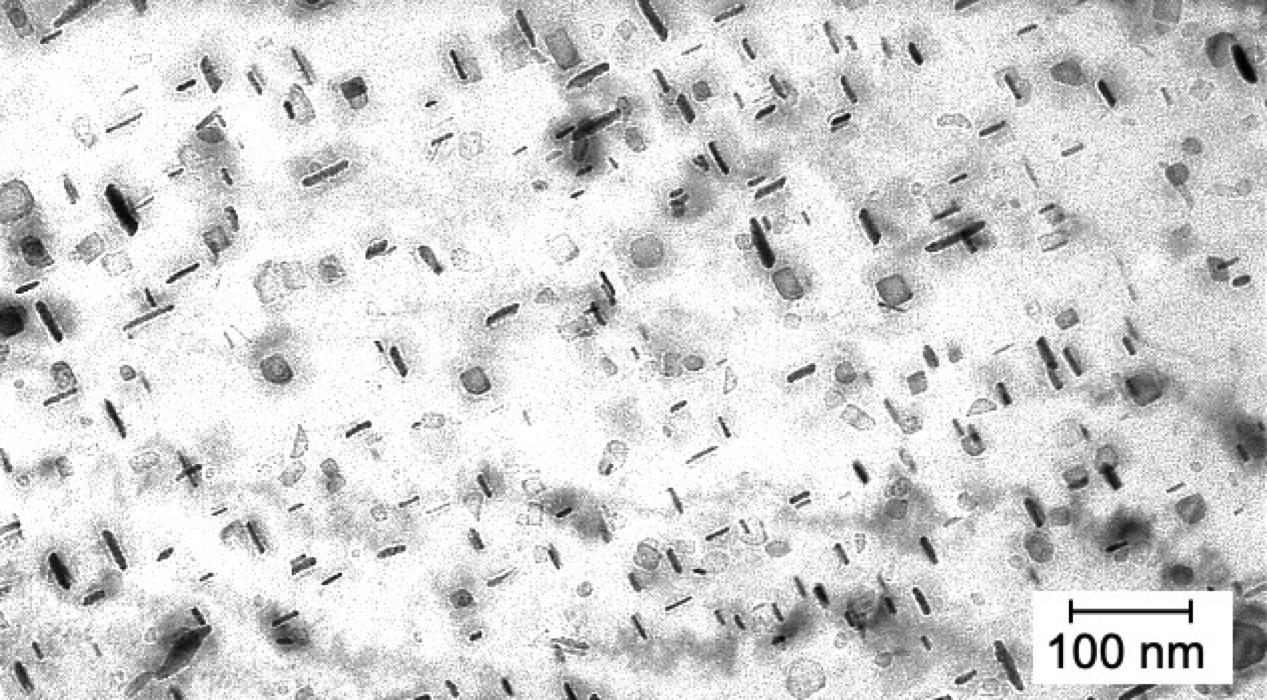
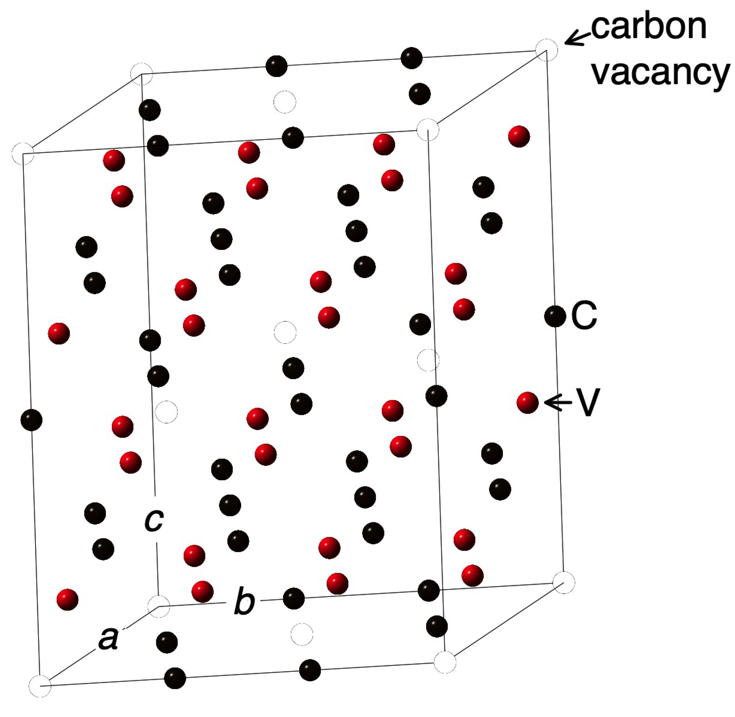
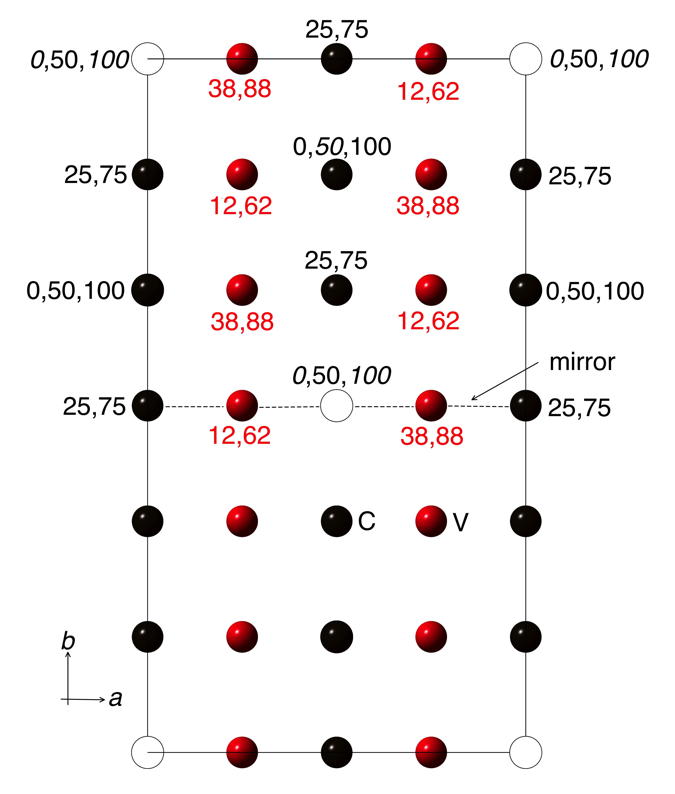
The vanadium carbide that precipitates in steel was thought originally to be V4C3 [Baker, 1959] with space group Fm3m and lattice parameter 0.4157 nm. However, a detailed examination of electron diffraction patterns has demonstrated that it is V6C5 with a monoclinic structure containing ordered vacancies in the carbon sublattice (Figure 2) [Billingham et al., 1972; Epicier et al., 2008]. The space group is C2/m, with lattice parameters a = 0.509 nm, b = 0.882 nm, c = 1.018 nm, β = 109.47°.
Given that the literature is full of interpretations based on V4C3, the following conversions apply, noting that the basis symbols 'M' and 'C' refer to the monoclinic and cubic forms respectively, and that [M; u] = (M J C)[C; u] and (h; M*) = (h; C*)(C J M):
Therefore, the classical Baker-Nutting orientation relationship between vanadium carbide and ferrite:
Vanadium carbide at the early stages of precipitation in austenite has the following orientation relationship:
Another vanadium carbide V8C7 has a cubic crystal structure (P4332, a = 0.832 nm) when the carbon vacancies are ordered. The order-disorder temperature is about 1125 °C. V8C7 occurs only in vanadium-rich steels such as those used in the manufacture of dies [Qi et al., 2018].
The following micrographs are taken from thin-foil samples studied using a transmission electron microscope.
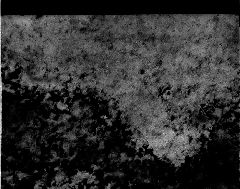 Tempered martensite in Fe–V–C steel.
|
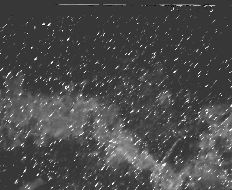 Tempered martensite in Fe–V–C steel.
|
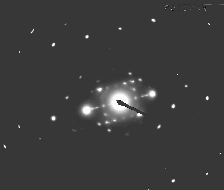 Tempered martensite in Fe–V–C steel.
|
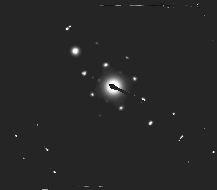 Tempered martensite in Fe–V–C steel.
|
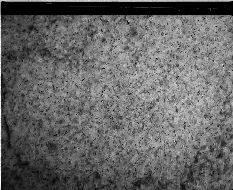 Tempered martensite in Fe–V–C steel.
|
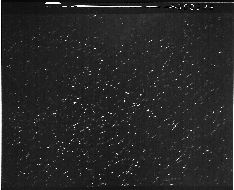 Tempered martensite in Fe–V–C steel.
|
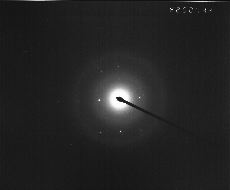 Tempered martensite in Fe–V–C steel.
|
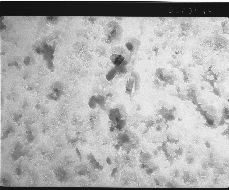 Tempered martensite in Fe–V–C steel.
|
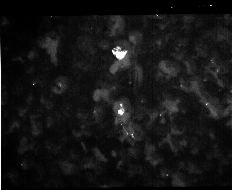 Tempered martensite in Fe–V–C steel.
|
An imaging atom-probe study of a mixed carbide particle in a steel containing titanium and vanadium. Bob wanted to confirm that there is a disturbance in the trajectories of the carbon at the edges of the particle, since the carbon distribution goes beyond the boundaries of the carbide particle. The possibility of such an aberration had been suggested to him by P. Turner.
Photographs courtesy of Dr Sally Waugh.
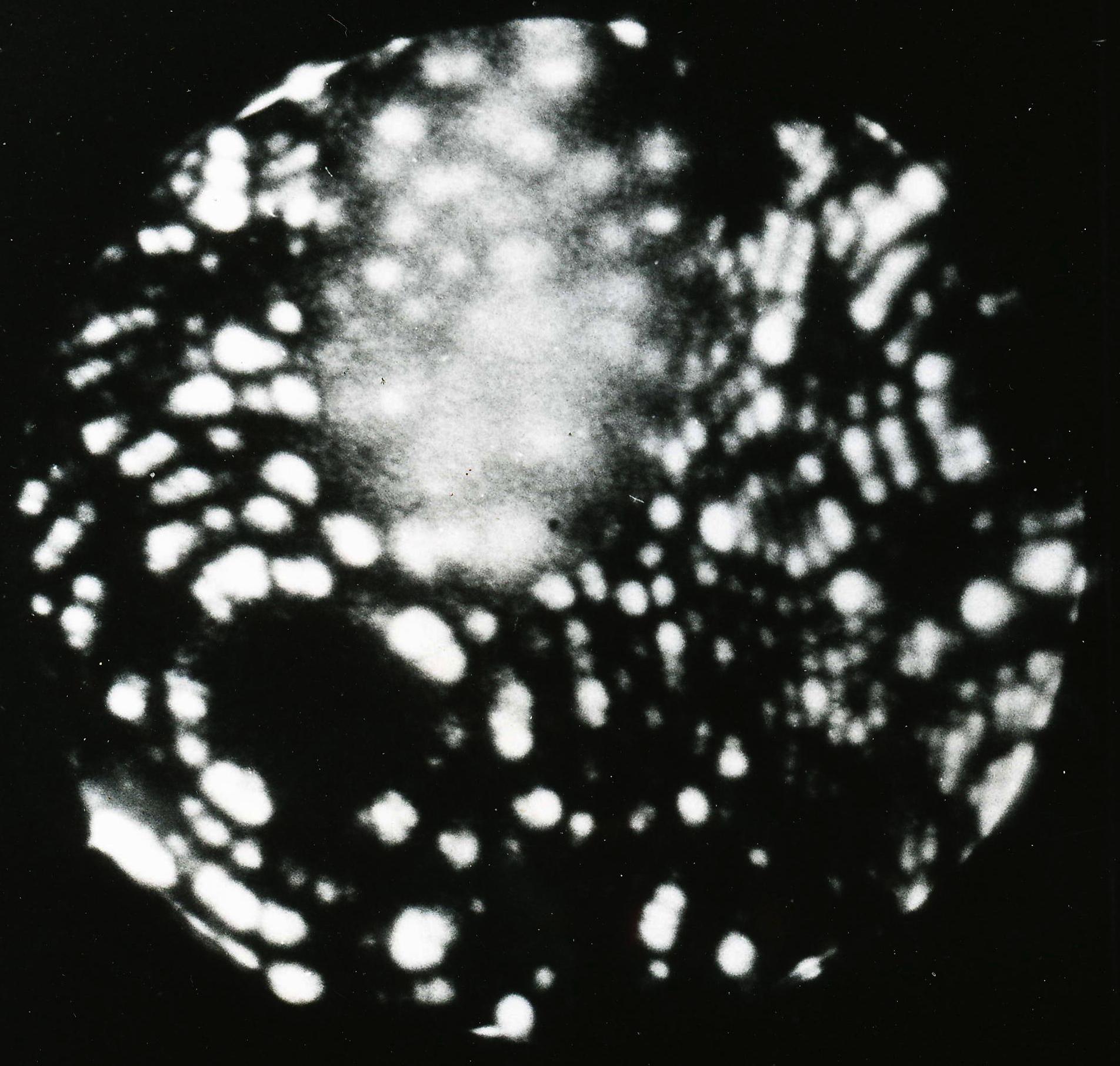
Neon field-ion image. |

An image with just the Fe2+ ions, showing the absence of iron in the carbide particle. |
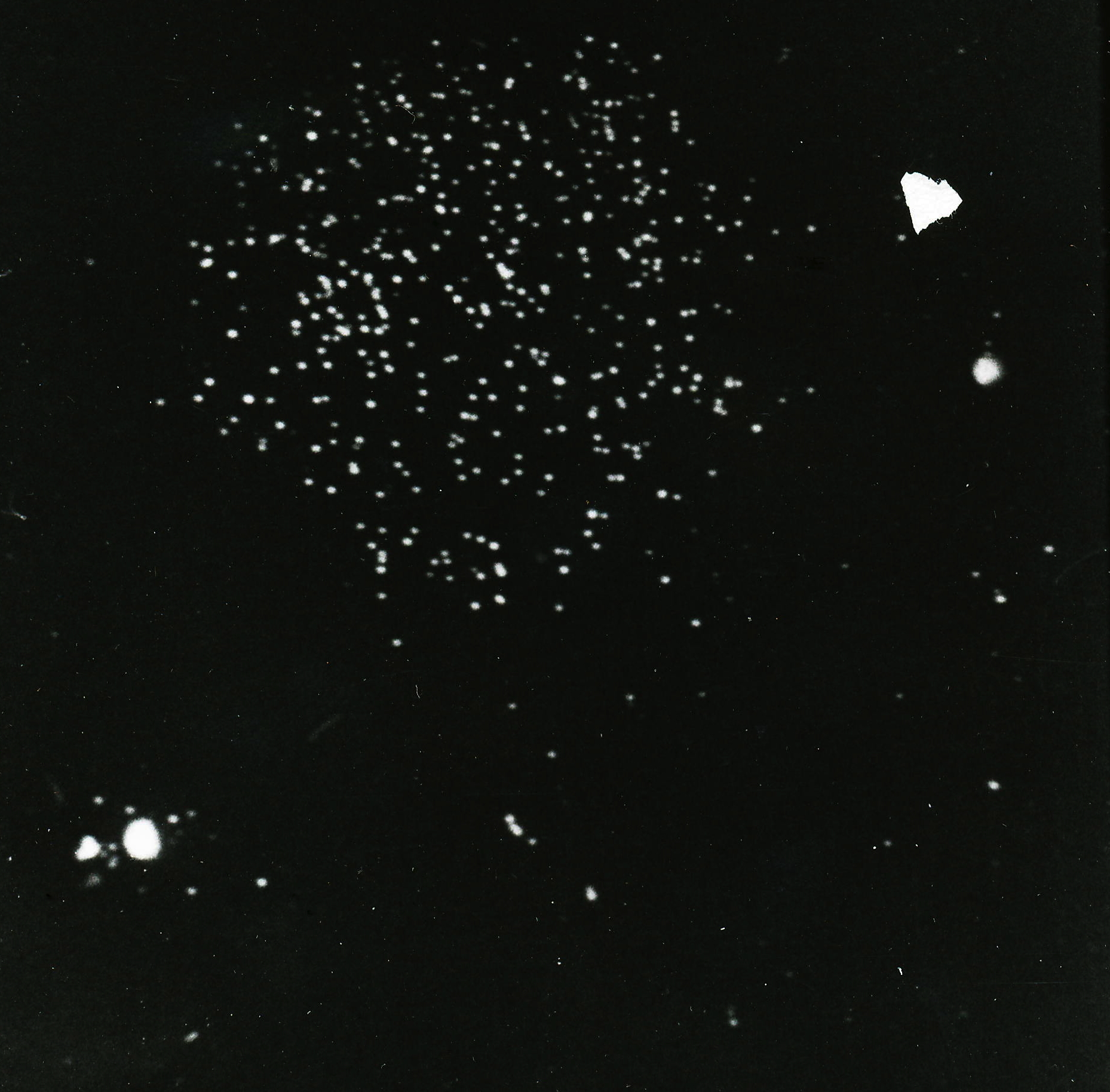
An image using the carbon C2+ ions. |

Combined image of the C2+ ions superimposed on the field-ion image. |
This study guide provides a comprehensive review of the materials science of vanadium carbide. It covers structural evolution, crystallographic relationships, and the role of these precipitates in steel metallurgy.
Instructions: Answer the following questions using 2–3 sentences based on the provided research.
Discuss the implications of the shift from V4C3 to V6C5 in the scientific literature. How do the mathematical conversions provided allow researchers to reconcile historical data with modern structural findings?
Analyse how vanadium carbide precipitates contribute to both mechanical hardness and resistance to hydrogen-induced failure. Contrast the role of coherency strain in these two distinct processes.