
Niobium carbide has a cubic-F lattice with a motif of Nb at 0, 0, 0 and carbon at 0, 0, 0.5. The carbide is not strictly stoichiometric but is represented here as such, with a lattice parameter of 4.4691 nm.
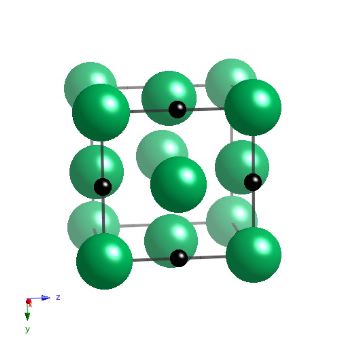
Crystal structure of NbC in perspective. |
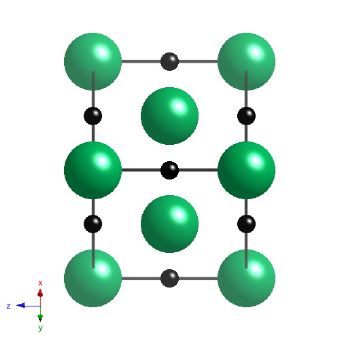
Projection of the crystal structure of NbC along a [110] direction. |
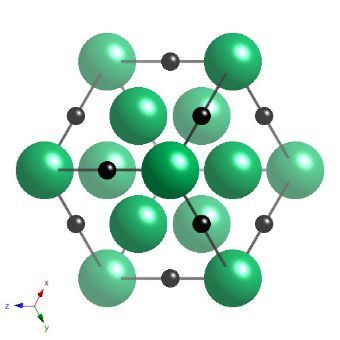
Projection of the crystal structure of NbC along a [111] type direction. |
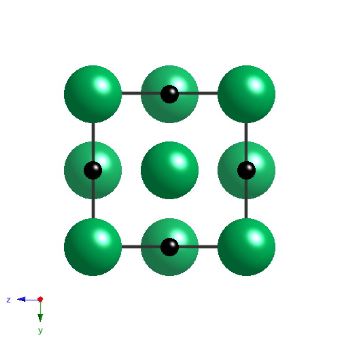
Projection of the crystal structure of NbC along a cube edge. |
Photographs courtesy of Dr Thomas Sourmail
The main production of niobium and an alloy of iron and niobium (ferroniobium) is at CBMM, Araxá, Brazil, where there are sufficient reserves to last for 500 years at current world consumption rates. The pyrochlore ore is mined simply by digging it out from open pits — at this stage it contains about 3% of Nb2O5. This is then enriched using the flotation process. The enriched ore is then reacted with aluminium to getter the oxygen and produce ferroniobium. Electron-beam refining is used to produce pure niobium. Most of the niobium produced is in the form of ferroniobium, which goes towards the production of huge quantities of microalloyed steels.
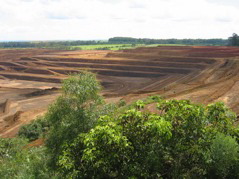
The open cast mine |
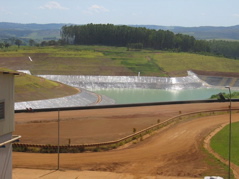
Flotation process to enhance the niobium content of the ore |
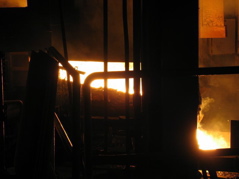
Hot ferroniobium |
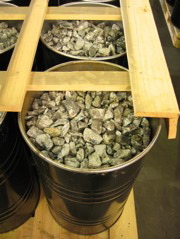
Ferroniobium |
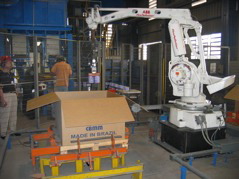
Packing tin cans of ferroniobium |
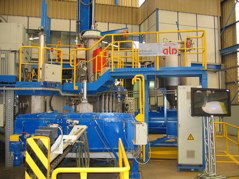
Electron beam furnace for the refinement of niobium metal, producing 210 tonnes per annum |
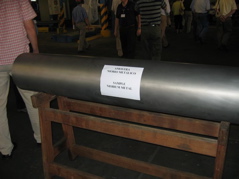
Electron beam refined niobium ingot |
|
The following micrographs are courtesy of Dr Mario C. Cordero-Cabrera.
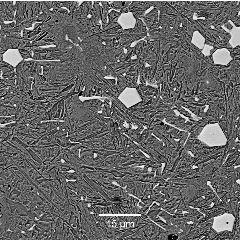
Fe-1.4C-6Cr-8Nb-1Si wt% hardfacing alloy. The white particles are niobium carbides (NbC) present in a matrix of retained austenite, martensite and some M7C3 particles. |
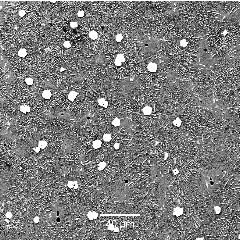
Fe-1.4C-6Cr-8Nb-1Si wt% hardfacing alloy. The white particles are niobium carbides (NbC) present in a matrix of retained austenite, martensite and some M7C3 particles. |
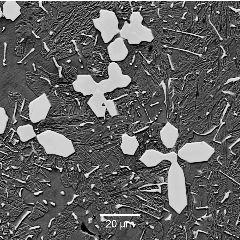
Fe-C-Nb-Si hardfacing alloy. The white particles are niobium carbides (NbC) present in a matrix of retained austenite, martensite, ferrite and some M7C3 particles. |
This study guide provides a comprehensive review of the metallurgy, production, and kinetic modelling of niobium carbonitrides based on research regarding their role in microalloyed steels, particularly high-strength line pipe alloys.
Instructions: Answer the following ten questions in two to three sentences, ensuring all factual details are derived from the source context.
Instructions: Use the provided source material to develop detailed responses for the following topics.
Discuss the two principal functions of niobium in thermomechanically processed steels: its role in grain-boundary pinning and its role as a solute in influencing hardenability.
Explain the challenges researchers face when trying to separate the effects of prior austenite grain size from the effects of soluble niobium on transformation kinetics. Describe the experimental methods used to isolate these factors.
Analyse the success of high-niobium, low-carbon pipeline steels (such as the X80). How has the quantitative understanding of niobium’s hardenability effect contributed to engineering design and the potential for new applications in construction?
Compare the multicomponent diffusion of niobium and carbon. Explain why modelling the precipitation of NbC is more complex than a simple binary system and how researchers ensure mass balance at the interface.
Using the provided solubility product equations, discuss how temperature and the presence of other alloying elements (like Manganese) affect the equilibrium of niobium and carbon within the austenite matrix.
| Term | Definition |
|---|---|
| Allotriomorphic Ferrite | A form of ferrite that nucleates at austenite grain boundaries and grows along them, often characterised by a reconstructive transformation mechanism. |
| Austenitisation | The process of heating a steel to a temperature where its structure transforms into austenite, allowing alloying elements like niobium to go into solid solution. |
| Capillarity (Gibbs–Thomson) | The phenomenon where the equilibrium solute concentration at an interface is altered by the curvature (radius) of the particle. |
| CCT Diagram | Continuous Cooling Transformation diagram; used to represent the phases produced in a material when it is cooled at various constant rates. |
| Ferroniobium | An alloy of iron and niobium, typically the form in which niobium is added to microalloyed steels during production. |
| Hardenability | The ability of a steel alloy to be hardened by the formation of martensite or the delay of reconstructive transformations (like ferrite) during cooling. |
| Pyrochlore | The primary ore from which niobium is extracted, notably found in significant reserves in Araxá, Brazil. |
| Soft Impingement | The overlap of diffusion fields from neighbouring growing precipitates, which reduces the local supersaturation and slows further growth. |
| Solubility Product | A mathematical constant (often temperature-dependent) that defines the equilibrium limit of dissolved elements in a matrix before precipitation occurs. |
| TTT Diagram | Time–Temperature–Transformation diagram; maps the kinetics of phase changes during isothermal (constant temperature) heat treatment. |