
Queen Mary University of London University of Cambridge

Molybdenum Carbide in Tempered Martensite

S. Yamasaki and H.K.D.H. Bhadeshia

Crystal Structure of Mo2C

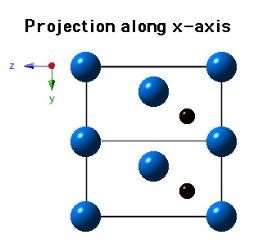
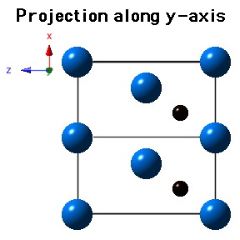
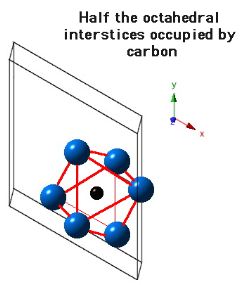
Molybdenum carbide (Mo2C) can occur in many crystalline forms, but that which precipitates in steels has a close-packed hexagonal crystal structure of metal atoms, with the carbon atoms located in one half of the available octahedral interstices (but the carbon atom locations are assumed). The lattice parameters assumed for the diagrams below are a = 0.3007 nm and c = 0.4729 nm.

Audio podcastAudio podcast

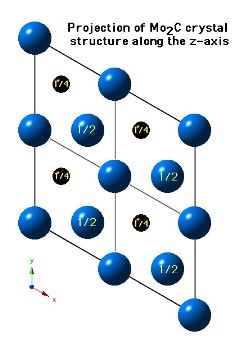
Mo2C Projection
Projection of four unit cells. The numbers indicate the fractional coordinates along the z-axis. The black atoms are carbon and the blue molybdenum.
Mo2C Unit Cell
Two molybdenum and one carbon atom per unit cell.
Mo2C side view Octahedral interstice projection
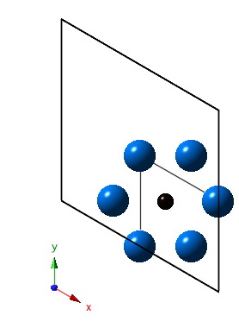
As the projection along the z-axis, but with most of the atoms removed to show carbon in an octahedral interstice.
Carbon interstice
Carbon in an octahedral interstice.

Molybdenum carbide needles in tempered martensite

The following micrographs are taken from thin foil samples using a transmission electron microscope.

Molybdenum Carbide in Tempered Martensite
Micrograph 0
Tempered martensite in Fe-Mo-C alloy.
Micrograph 1
Tempered martensite in Fe-Mo-C alloy.
Micrograph 2
Tempered martensite in Fe-Mo-C alloy.
Micrograph 3
Tempered martensite in Fe-Mo-C alloy.
Micrograph 4
Tempered martensite in Fe-Mo-C alloy.
Micrograph 5
Tempered martensite in Fe-Mo-C alloy.
Micrograph 18
Molybdenum carbide precipitation.
Micrograph 19
Molybdenum carbide precipitation.
Micrograph 20
Molybdenum carbide precipitation.

Study guide: carbides in steels and transformations

Crystallography, morphology, and thermodynamic properties of molybdenum carbides.

Part I: Short-Answer Quiz

Instructions: Answer the following ten questions in 2–3 sentences.

  1. What is the basic metal atom arrangement and carbon distribution in the hexagonal model of Mo2C that precipitates in steels?
  2. Why was neutron diffraction necessary to correctly identify the orthorhombic structure of Mo2C?
  3. In the context of lattice parameters, how do the hexagonal (ah, ch) and orthorhombic (a, b, c) representations of Mo2C relate to one another?
  4. How does the growth morphology of Mo2C in a ferrite matrix differ from its shape in unconstrained environments like catalysis?
  5. What determines the specific needle-like growth direction of Mo2C within a ferrite crystal?
  6. Regarding M7C3 carbides, what does recent research suggest about the nature of the streaks previously identified as stacking defects?
  7. What is the primary industrial motivation for adding large concentrations of aluminium to steel alloys?
  8. How do manganese and carbon contribute to the physical properties of low-density Fe-Mn-Al-C alloys?
  9. Why has the orientation relationship between molybdenum carbide and austenite never been experimentally measured at typical steel compositions?

Part II: Answer Key

  1. Metal atom and carbon distribution: The molybdenum atoms form a close-packed hexagonal crystal structure. The carbon atoms are located in one-half of the available octahedral interstices, though their specific locations are often assumed in traditional hexagonal models.
  2. Neutron diffraction vs. X-ray: Carbon atoms have very weak X-ray scattering power compared to molybdenum, making their positions difficult to verify with X-ray diffraction. Neutron diffraction is superior for this task because the scattering powers of carbon and molybdenum atoms are similar, allowing for the identification of the true orthorhombic symmetry (space group Pbcn).
  3. Lattice relationships: The hexagonal and orthorhombic representations share identical relative metal atom positions. The basis relationship is defined as ach, b → 2ah, and c → √3ah, with the orthorhombic parameters measured as a = 0.4724 nm, b = 0.6004 nm, and c = 0.5199 nm.
  4. Growth morphology: In a ferrite matrix, Mo2C precipitates as thin needles to minimise strain energy. When synthesised for catalysis or formed via vapour deposition without matrix constraints, the particles approximate spheroids, faceted plates, or faceted platelets.
  5. Needle growth direction: The needles grow along the ⟨100⟩α directions of the ferrite. This specific orientation occurs because the distortion (misfit) along the [100]α ≈ [010]O direction is small compared to orthogonal directions, effectively limiting growth in high-distortion dimensions to minimise strain.
  6. Streaks in M7C3: Recent crystallographic studies suggest these streaks are not stacking defects, but rather represent the coexistence of two crystallographic variants of the carbide. Each variant is approximately 5–10 nm thick, and the structure is best indexed as hexagonal with space group P63mc.
  7. Aluminium additions: The main goal of adding aluminium is to reduce the density of the steel by increasing the lattice parameter of pure iron and reducing the average atomic mass. Additionally, aluminium has long been recognised for enhancing the oxidation resistance of the alloy.
  8. Manganese and carbon roles: Manganese and carbon are added to increase the thermodynamic stability of the austenite phase, which aluminium typically destabilises. Furthermore, since both are lighter than iron, they contribute to the overall reduction of the alloy's density (e.g., down to approximately 6.8 g cm−3).
  9. Austenite orientation measurement: At typical steel compositions, molybdenum carbide is not thermodynamically stable when in a mixture with austenite alone. Consequently, direct observations of precipitation in austenite are unavailable, and the orientation relationship must be assumed or inferred from other interfaces.

Part III: Essay Format Questions


Part IV: Glossary of Key Terms

Mo2C
Molybdenum carbide; in steels, it precipitates as orthorhombic needles (space group Pbcn) within a ferrite matrix.
Ferrite (α)
The body-centered cubic (BCC) phase of iron; serves as the matrix for Mo2C needle precipitation in tempered martensite.
Lattice Parameters
The physical dimensions of the unit cell in a crystal lattice (e.g., a, b, c for orthorhombic; a, c for hexagonal).
Neutron Diffraction
A form of crystallographic study particularly useful for locating light atoms like carbon in the presence of heavy atoms like molybdenum.
Octahedral Interstice
The "holes" or spaces within a close-packed crystal structure where smaller atoms, such as carbon, are situated.
Orientation Relationship (OR)
The specific geometric alignment between the crystal lattices of two different phases.
Strain Energy
The energy stored in a material due to the deformation of its lattice; in precipitation, it is minimised by selecting specific growth shapes.
Tempered Martensite
A microstructure formed by heating martensite to allow for the precipitation of carbides, which increases toughness.

Pearlite in steels
Published 2025
Audio summaries
Steels 5th edition Published 2024
Bainite 3rd edition Free download
Crystallography 1st edition Free download Audio, video summaries
Bainite at play Published 2026 video
Theory of transformations in steels Free download
Functional Materials Free book Hard copy
Phase transitions
Free book,
source (CC-BY)
Isolation Free download
rail steels
Rails, 2024
Audio summary
Bainite in Steels, Chinese edition Translation, 2020
Innovations in everyday engineering materials
Published 2021